APIs and MCP both connect AI agents to business systems, but they work in very different ways. Learn how each one fits into Salesforce-connected customer conversations, when to use APIs, MCP, or both, and what neither can do on its own.
Let’s take a peek into this world with a very realistic, real-world scenario involving Customer (“C”), a real-estate agency (“Business”), and the company’s AI Assistant.
Customer messages Business via WhatsApp to reschedule an appointment to view a new property. To help Customer, AI Assistant goes through the following steps:
- Identify Customer from their intake form
- Review Customer’s details (name, contact details, property preferences, financing status, etc.)
- Find Customer’s appointment details
- Check assigned agent’s upcoming availability
- Find an alternative slot
- Offer new slot to Customer
- Customer accepts new appointment
- Conversation ends
- Record the new appointment details, customer responses, and interaction outcomes in the CRM
This above transaction appears straightforward to Customer. However, it is quite complex and involves a lot more than AI Assistant simply generating an appropriate conversational response (although it does do this).
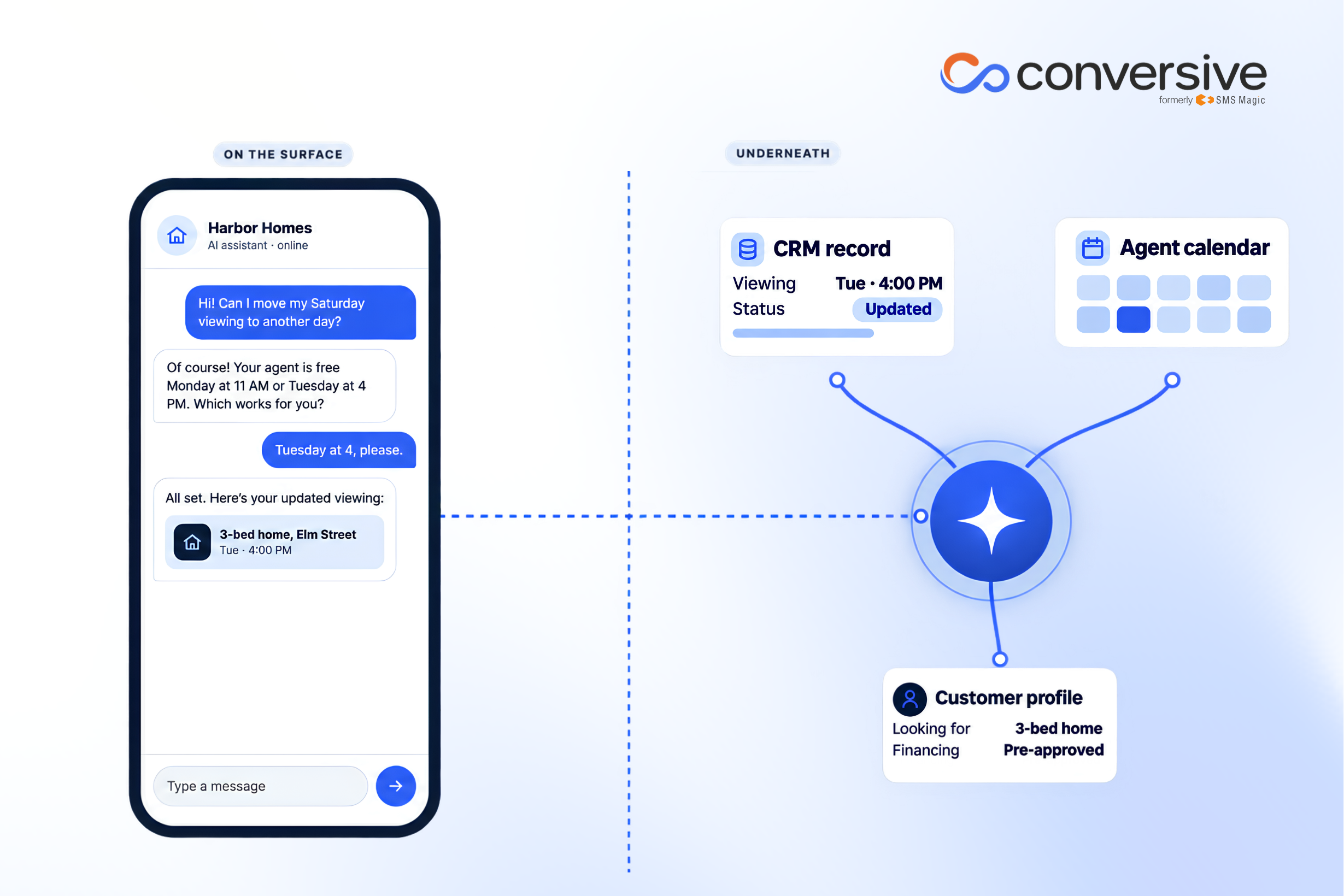
Behind the scenes, AI Assistant autonomously communicated with the underlying systems holding Customer’s records and scheduling information. It also understood the context of the conversation, interpreted the customer's responses, adjusted its own responses accordingly, and communicated the new appointment date to the Customer, and finally, updated the underlying system of record – the CRM.
This entire process is possible because of three powerful technologies working in the background: Application Programming Interfaces (APIs), Model Context Protocol (MCP), and a communication platform.
In this article, we’ll compare MCP vs. APIs. We’ll explore where each technology fits into Salesforce-connected customer conversations, and where they fall short.
MCPs vs. APIs: Purpose and Differences
APIs and MCP both help systems talk to each other, but they serve different users. APIs follow fixed rules that developers write in advance, while MCP lets AI agents discover and use tools at runtime. Here’s how each works, and where they differ.
What is an API?
An API is a set of established methods and definitions that enable applications to communicate with each other, and execute some predefined operations.
Purpose of APIs: Define how software applications exchange information and perform actions
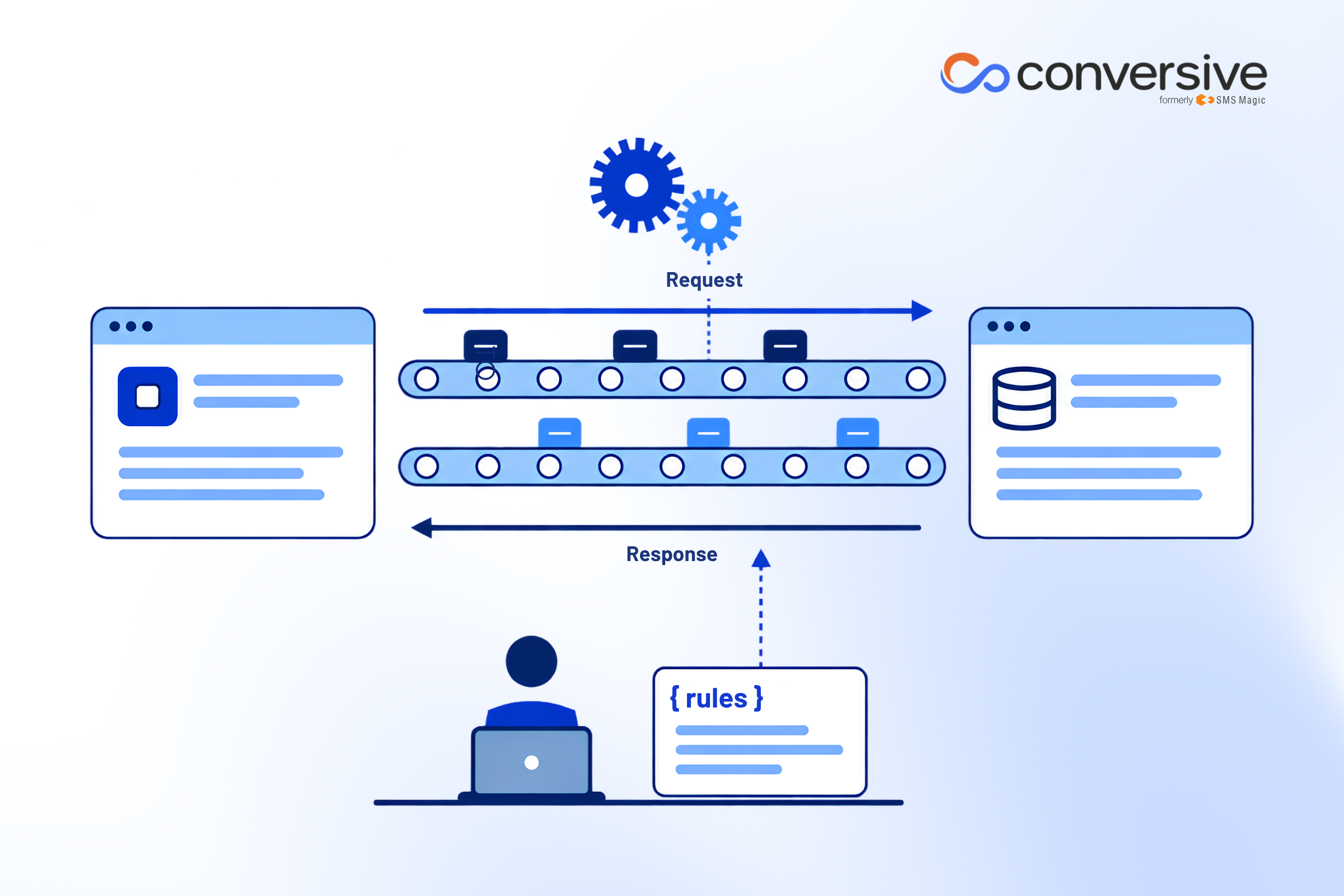
Built for deterministic systems, APIs provide the rules and specifications that allow software applications to exchange data with each other. Thanks to APIs, the applications can request specific operations without having to understand the internal workings of the connected system. When developers build applications, they set up hard-coded rules that determine how those applications will behave, which endpoints the applications need, how requests should be structured, and how responses should be handled.
For example, A Salesforce REST API works in the background to help a business create, retrieve, and update a customer's contact information within their Salesforce record.
What is MCP?
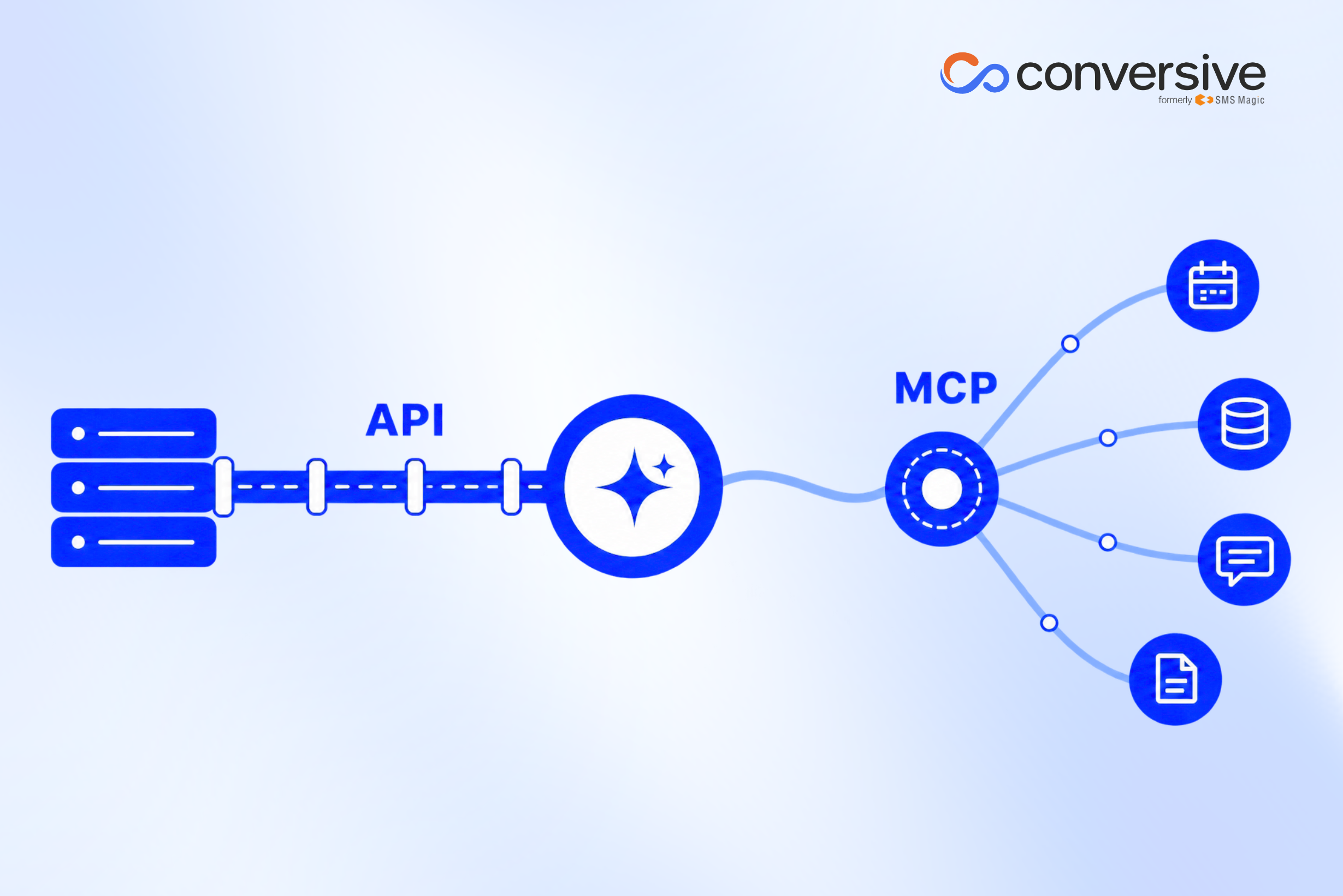
MCP provides a standardized way for AI models and applications to discover, connect to, and use external tools and data sources without requiring developers to write custom code for every AI app.
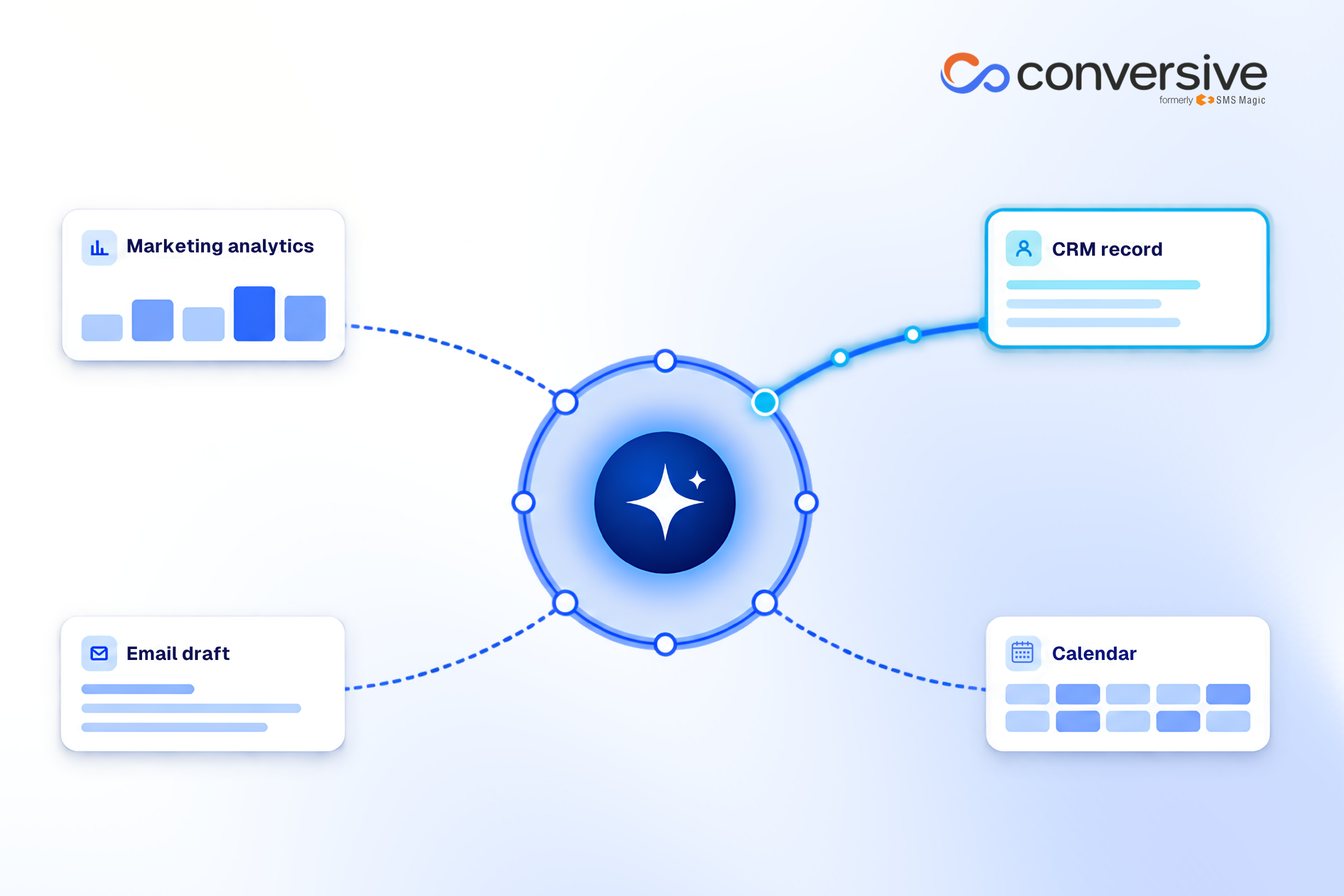
Together, APIs and MCP support connectivity and communication between AI agents and other systems. However, they work differently and serve different purposes.
Purpose of MCP: Standardize how AI applications discover and use external tools
Developed in 2024 by AI firm Anthropic, MCP is an open standard that helps simplify connections between AI applications and external systems, tools, and contextual resources. This uniform protocol provides a consistent interface and context through which AI applications and agents can dynamically discover, invoke, and interact with available capabilities (tools, resources, prompts) based on task intent.
A Salesforce AI agent may use MCP to execute complex, multi-step, real-world actions. For example, it could pull data from a marketing tool and then compare it to sales records in the CRM. Based on this analysis, it could automatically draft and schedule a marketing campaign to reach more potential customers.
Key Differences between APIs and MCP
Here are the key differences between APIs and MCPs:
MCP, APIs, or both: What should businesses choose?
So which technology should a Salesforce-enabled business choose?
Which technology is “better” than the other?
The answer: it depends on the workflow type, the level of AI involvement, and the systems that need to be connected. So, considering the below scenarios can help organizations choose and implement the right approach for their requirements.
Scenario#1: If operations are predictable and application integrations are already well-established, us APIs
APIs are most effective when some predefined operations, i.e. operations that need to follow established business rules and predictable steps, must be executed consistently and with 100% reliability. Such operations usually do not require AI agents to decide which integration to invoke and use, or to figure out the next steps.
Here are some examples of such workflows:-
- Sending automated reminders (e.g., upcoming appointment)
- Sending transactional SMS notifications (e.g., order confirmation)
- Updating Salesforce records (contacts, service cases, etc.)
- Synchronizing customer statuses between applications
- Receiving webhook notifications when a specific event occurs (e.g., a customer submits a form on the company website)
Scenario#2: If AI agents need access to different tools and systems, use MCP
When an AI application needs a standardized way to discover and interact with multiple external capabilities, businesses can consider MCP. An MCP server enables the AI system to autonomously decide which tool to use based on a user's (natural language) request.
Here are some examples:-
- Selecting a permitted customer lookup tool
- Retrieving information from connected enterprise services
- Checking an order status and initiating an approved follow-up
- Discovering and checking unpaid invoices and drafting a polite reminder email
In all the above examples, the AI system selects an appropriate tool on its own based on a specific request, rather than relying on a developer to build an entirely separate integration for every interaction pattern.
Scenario#3: If workflows are AI-assisted and involve multiple systems and tools, use MCP and APIs together
Many processes, particularly those involving customer communications, benefit from combining both technologies. The MCP layer provides a standardized interface for AI agents to access available capabilities while underlying APIs execute particular actions in connected business systems. With the MCP serving as the contextual translation layer, AI agents can dynamically understand, discover, and execute APIs.
That said, not every customer communication task requires an MCP server, especially if the task involves system-to-system integrations without an agentic AI client.
For example, a reminder that must be sent 24 hours before every appointment can usually be handled through a predefined automation workflow and API integration. On the other hand, an AI assistant responding to an unexpected customer request – such as a request to reschedule an upcoming appointment may benefit from selecting among multiple tools. In these scenarios, an MCP server that handles all agent-specific integrations is a better choice.
MCP and APIs: Different but capable of working together within the same workflow
As we have seen, MCP and API are two different technologies. However, they can work well together within the same workflow. APIs expose endpoints and predefined operations to software, making them particularly useful for predictable integrations and repeatable business processes. MCP does not replace existing APIs. Rather, it wraps around APIs and allows AI agents to dynamically discover capabilities and access real-time context during runtime. The agent can then autonomously determine which tool to invoke and take the next step in the interaction based on the end goal.
APIs and MCP together are particularly useful in customer communication workflows, especially if a customer communication workflow and platform are also part of the architecture.
Here are some scenarios that illustrate this usefulness.
In each of these scenarios, the customer-facing interaction and the connected business operation are separate activities. Such separation enables businesses to build more flexible customer communication processes and ensure that context travels with the customer across every channel. This way, every message is not an isolated conversation, but becomes part of one continuous customer journey designed to lead to a measurable outcome (conversion, long-term retention, and so on).
The Limitations of APIs and MCP in customer communication
APIs expose endpoints and predefined operations to software, making them useful for predictable integrations and repeatable business processes. MCP operates as an additional middleware layer that makes established APIs integrations accessible to AI applications. An MCP server may expose a tool that calls an existing API. This removes the need for custom integration code for every platform.
However, MCP does not independently determine what an AI agent should do, nor does it guarantee that a selected action is appropriate. It also cannot maintain a customer's conversation history across channels and touchpoints. Such context is vital to minimize friction during customer communications and ensure that each interaction is meaningful and valuable – both to the customer and the business.
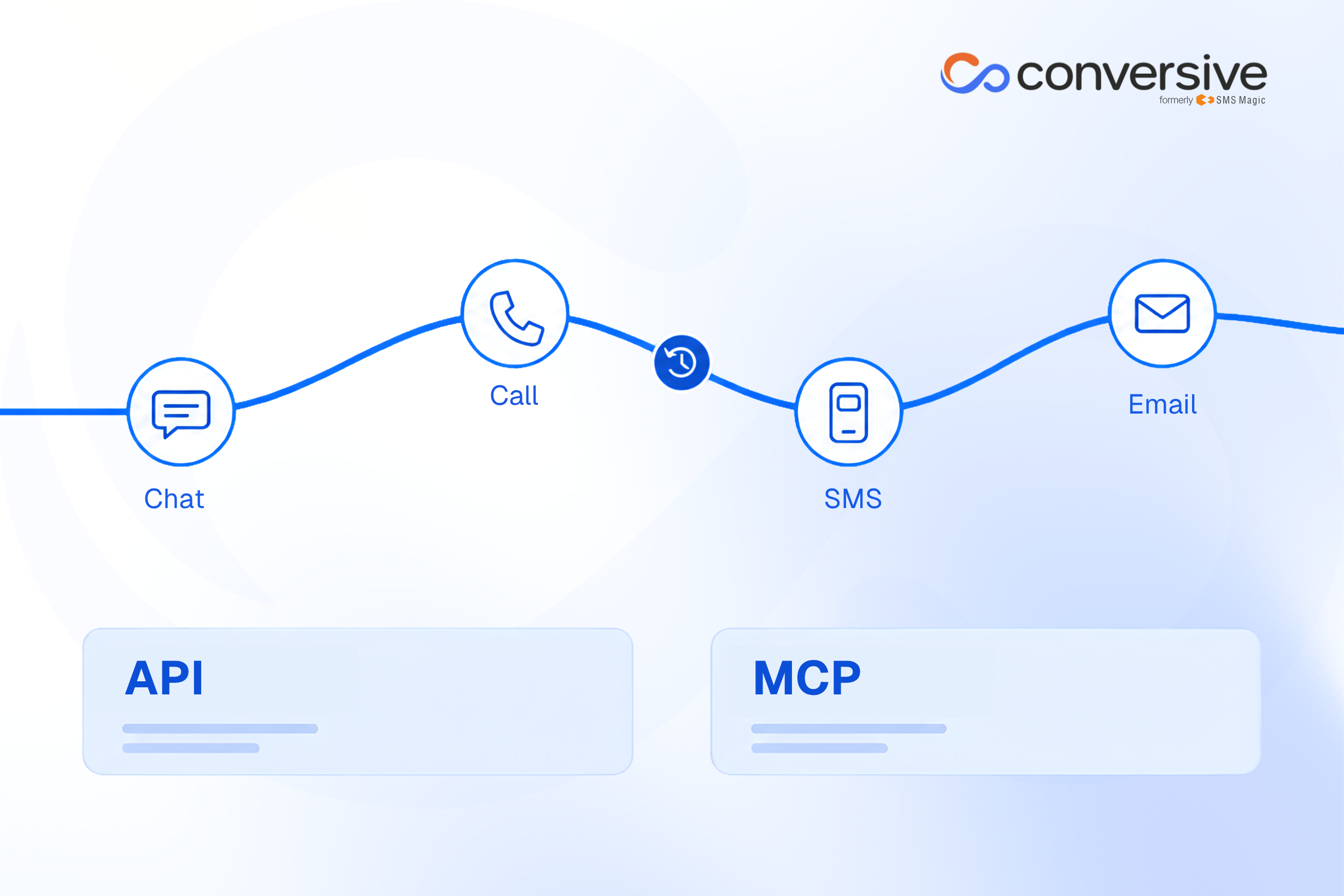
Consider an AI assistant scenario here. The Assistant retrieves the customer’s information from Salesforce. An API acts as the underlying machinery that moves the data. However, it cannot determine which endpoint to call on the fly. An intelligent translator, the MCP server, is required for this.
The MCP server allows the AI agent to dynamically discover and execute those APIs – and to retrieve the Salesforce data in a format the agent can understand. The Assistant then uses this information to determine the next step in the interaction.
So, both technologies play a part in retrieving the customer information required to facilitate the customer conversation. However, they cannot independently manage that interaction. Carrying out the conversation independently and seamlessly requires channel management, customer understanding, maintenance of conversation history, response handling, triggering personalized customer journeys on real-time intent, and appropriate follow-up processes. And all of this needs to happen in real-time so the customer is not left waiting for answers, made to repeat information on different channels, or worse, forced to start conversations from scratch.
This is exactly why APIs and MCP need to be complemented with an intelligent customer communication solution. One such solution is Conversive.
Transform your connected business systems into customer conversations with Conversive
By connecting business applications, Salesforce-powered organizations can leverage Salesforce as a unified, single-source-of-truth for the entire business. They can eliminate data siloes and manual errors, and automate cross-system workflows, such as customer communications. However, system integration is only one part of engaging in delightful conversations and delivering memorable customer experiences. Firms also need to manage customer interactions across all supported messaging and voice channels.
This is exactly what Conversive is designed for.
Conversive is a Salesforce-connected customer communication platform that helps firms manage, continue, and act on conversations in complex, omnichannel settings. In doing so, they can capture and convert more demand at every stage of the customer journey. Ideal for demand-driven, inquiry-led, and conversation-heavy businesses, Conversive understands, remembers, and most importantly, acts – thus helping to boost customer engagement, conversions, and revenues.
Conversive does not replace Salesforce, APIs, or MCP. Rather, it complements all these technologies by focusing on the workflows surrounding customer interactions. With Conversive, AI agents get what they may be lacking – telephony, memory and industry-specific context. This way, agents always have the right context to understand who the customer is, what they need, how the business works, and what should happen next.
Such a connected, contextual approach turns every customer interaction into a goal-directed journey and ensures that demand doesn’t fall through conversational cracks. This enables organizations to capture and convert more demand, and recover more revenues than would be possible with just Salesforce, MCP, and APIs.
Schedule a free demo to discover how Conversive can reduce your customers’ wait times by 75% and reduce first response times to less than 60 seconds.
Frequently Asked Questions (FAQs)
1. Does MCP replace REST APIs?
No. MCP and REST APIs serve different purposes. REST APIs allow applications to communicate with each other. MCP provides a standardized interface to connect AI applications to external tools and data sources.
2. Can AI agents use APIs without MCP?
Yes. AI agents can access APIs directly through function-calling mechanisms or tool use patterns. MCP, while not mandatory, is useful because it helps standardize how AI agents discover and interact with external tools.
3. Does MCP automatically give AI agents conversation memory?
No. MCP does not independently maintain persistent conversation records and interaction history. A separate communication platform is required for this purpose.
4. How does MCP work with Salesforce Agentforce?
MCP functions as a universal communication bridge, allowing Salesforce Agentforce AI agents to dynamically discover and use external data, tools, and workflows.
5. Is MCP required for AI-powered customer communication?
No. Many customer communication workflows operate effectively through standard REST APIs or point-to-point software integrations. However, when a standard way is needed to connect AI models to multiple external capabilities, MCP is useful.
6. Is MCP more secure than an API?
Neither approach is more inherently secure than the other. APIs are a safer approach for strictly governed data pipelines, while MCP server is a safer architecture when AI agents have the power to autonomously execute tasks. Organizations should be aware of the risks of both approaches and implement appropriate guardrails to ensure that AI agents can access only approved customer information and business tools.