A conversational AI workflow can answer patient enquiries, schedule appointments, follow up on referrals, and route sensitive requests to staff. This article covers its healthcare use cases, EHR connections, HIPAA requirements, rollout process, and role in reducing patient drop-offs.
A patient calling to reschedule an appointment shouldn’t have to wait 20 minutes. A referral should not remain unattended because the team could not reach the patient during working hours. Yet it happens and is very common across hospitals, clinics, and diagnostic centres.
Conversational AI in healthcare helps organizations manage such interactions through automated voice calls, SMS, WhatsApp, and web chat. It can answer routine questions, schedule appointments, collect intake information, follow up on referrals, send reminders, and route complex cases to the right staff member.
Healthcare automation comes with stricter requirements than automation in most other industries. The system must protect patient health information, follow defined access rules, maintain reliable records, and transfer conversations to clinical or administrative teams at the right moment. It must also support patients without presenting itself as a replacement for medical judgement.
This article explains how conversational AI works across healthcare workflows, where it can be used, how it connects with EHR and scheduling systems, and what healthcare leaders should assess before choosing a platform.
What Is Conversational AI in Healthcare? How Does It Work?
Conversational AI in healthcare refers to software that can interpret patient requests, respond in natural language, and complete approved tasks across voice and messaging channels. It can support conversations through phone calls, SMS, WhatsApp, website chat, and patient portals.
A patient may use it to find a doctor, schedule an appointment, request a prescription refill, confirm pre-visit instructions, or ask about a referral. The system identifies what the patient needs, checks the relevant healthcare system, and either completes the request or transfers the conversation to a staff member.
Healthcare conversational AI combines several technologies:
- Natural language processing helps the system process written or spoken language.
- Natural language understanding identifies the patient’s intent, such as booking an appointment or checking a referral.
- Speech recognition converts spoken words into text so that voice AI agents can process phone conversations.
- Speech generation converts the response into natural-sounding audio.
- Large language models allow the system to respond more flexibly than a fixed phone menu or rules-based chatbot.
- Workflow controls determine what actions the system can complete and when staff involvement is required.
- Healthcare system integrations connect the conversation with appointment calendars, EHR platforms, CRM records, and contact-centre tools.
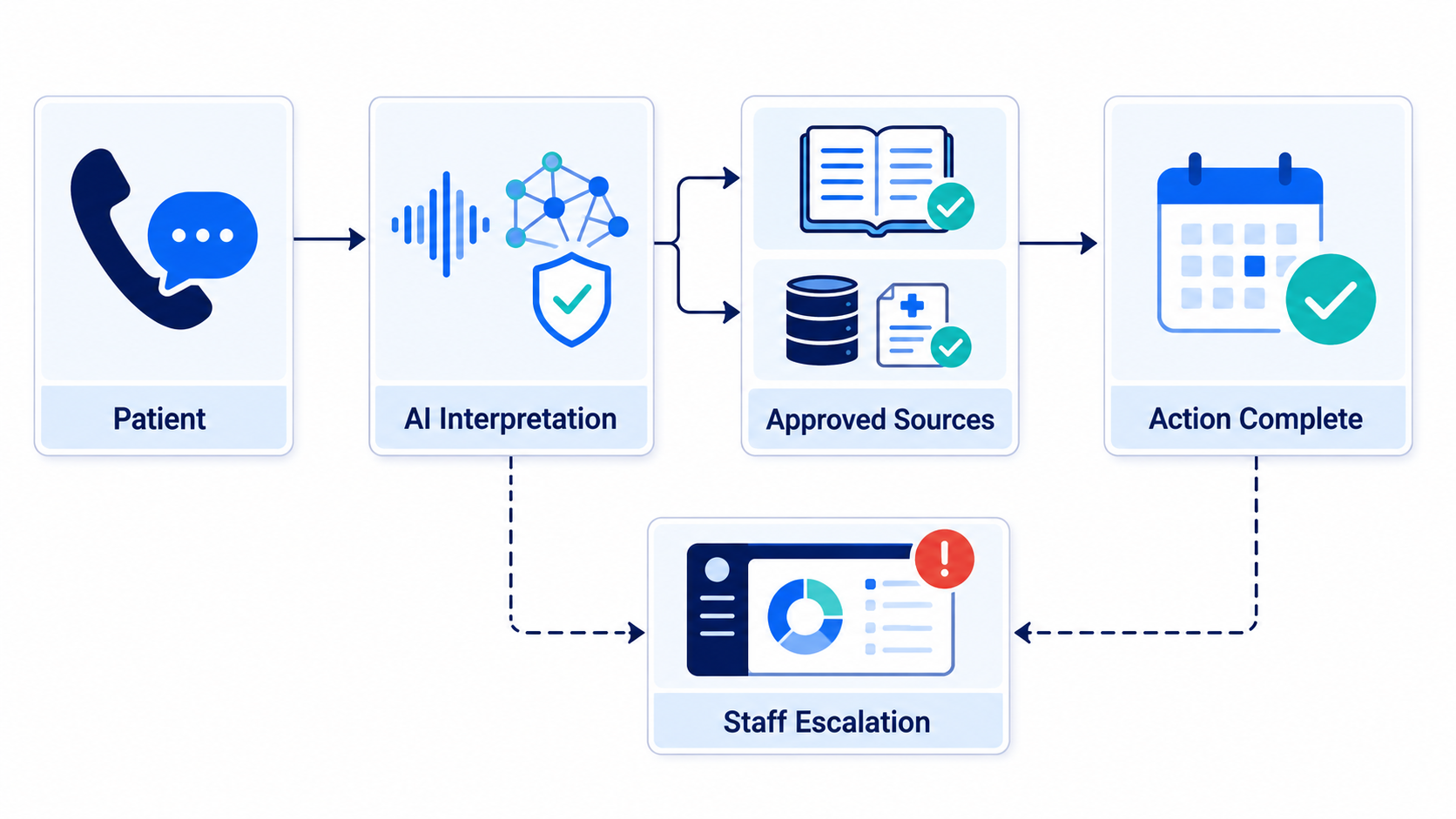
A typical interaction follows these 5 steps:
- The patient starts a conversation through a phone or messaging channel.
- The system identifies the patient’s language, intent, and requested action.
- It checks approved information or retrieves permitted data from a connected system.
- It provides an answer or completes an action, such as rescheduling an appointment.
- It transfers the conversation when the request requires medical judgment, manual review, or additional verification.
How is conversational AI different from a traditional chatbot?
Traditional chatbots usually rely on predefined questions, buttons, or keyword-based responses. They work well when patients follow an expected path but may fail when a request is phrased differently.
Modern AI agents can maintain context across a conversation, ask follow-up questions, retrieve information from connected systems, and complete permitted actions.
Benefits of Conversational AI for Healthcare Providers
Conversational AI helps healthcare providers respond to more patients without placing every interaction on clinical or call-centre staff. The outcome depends on the workflow selected, the systems connected, and the rules used for escalation.
When these elements are set up correctly, conversational AI can reduce delays across the patient journey:-
1. Patients can receive support outside working hours
Patients often search for care, request appointments, or ask questions after call centres have closed. Conversational AI can support patients after regular hours, provide approved information, capture the patient’s request, schedule an available slot, or arrange a callback. This gives patients a clear next step without requiring healthcare organizations to staff every channel around the clock.
2. Call-centre teams can focus on cases that require human support
A large share of inbound calls relate to appointment availability, directions, preparation instructions, referral status, and operating hours. AI agents can handle these repetitive requests while staff manage cases involving judgment, exceptions, or sensitive conversations.
3. Administrative tasks can be completed faster
Conversational AI can support routine workflows such as:
- Scheduling, rescheduling, and cancelling appointments.
- Sending appointment and medication reminders.
- Collecting pre-visit information.
- Following up on incomplete referrals.
- Routing prescription refill requests.
- Sharing approved billing and insurance information.
- Conducting administrative post-visit check-ins.
Automation reduces the number of manual calls and messages required to move patients through these processes.
4. Patient communication can become more consistent
Different locations and departments may give patients different instructions. Approved conversational workflows provide consistent information across voice and messaging channels. They can also support multiple languages, depending on the platform and configuration.
5. Providers can measure where conversations break down
Conversation data can show why patients contact the organization, where they abandon scheduling, which requests require staff transfers, and which workflows remain incomplete. Teams can then use this information to correct specific communication gaps.
Where Can Conversational AI Be Used in Healthcare?
Conversational AI healthcare use cases extend across the full patient journey, from the first service enquiry to post-discharge follow-up. The safest starting points are usually high-volume, repeatable workflows with clear rules and defined conditions for staff transfer.
1. Patient discovery and service enquiries
Patients often contact a healthcare provider before they know which department, location, or specialist they need. Conversational AI can answer approved questions about:
- Services and specialities.
- Provider locations and operating hours.
- Accepted insurance plans.
- Available appointment types.
- Preparation requirements.
- Directions and parking information.
If the patient’s request cannot be matched to an approved answer, the system can collect their details and transfer the enquiry to the right team.
2. Appointment scheduling and management
Scheduling is one of the most practical applications of conversational AI in patient engagement. When connected to an appointment system, an AI agent can check availability, offer suitable time slots, confirm bookings, and send reminders.
Patients may also be able to reschedule or cancel appointments without calling the front desk. Cancelled slots can be offered to patients on a waitlist, helping providers use available capacity more efficiently.
3. Digital patient intake
Conversational AI can collect demographic details, visit reasons, consent information, insurance details, and responses to approved intake questions before the appointment.
The collected information can be sent to the appropriate system or staff queue for review. Questions involving symptoms or care decisions should follow clinical protocols and trigger staff involvement when required.
4. Referral coordination
Referrals can stall when documents are missing, patients cannot be reached, or responsibility is unclear between departments. Conversational AI can confirm that a referral was received, notify the patient about the next step, request missing administrative information, and continue follow-ups until an appointment is booked.
The system can also flag referrals that remain incomplete after a defined number of contact attempts.
5. Prescription refill routing
A conversational system can collect the medication name, pharmacy information, and request details before routing them to the permitted clinical queue. It can then notify the patient when the request has been received or reviewed.
The AI should not approve a refill or alter a prescription independently. Its role is to collect, route, and communicate information according to the provider’s workflow.
6. Post-discharge follow-ups
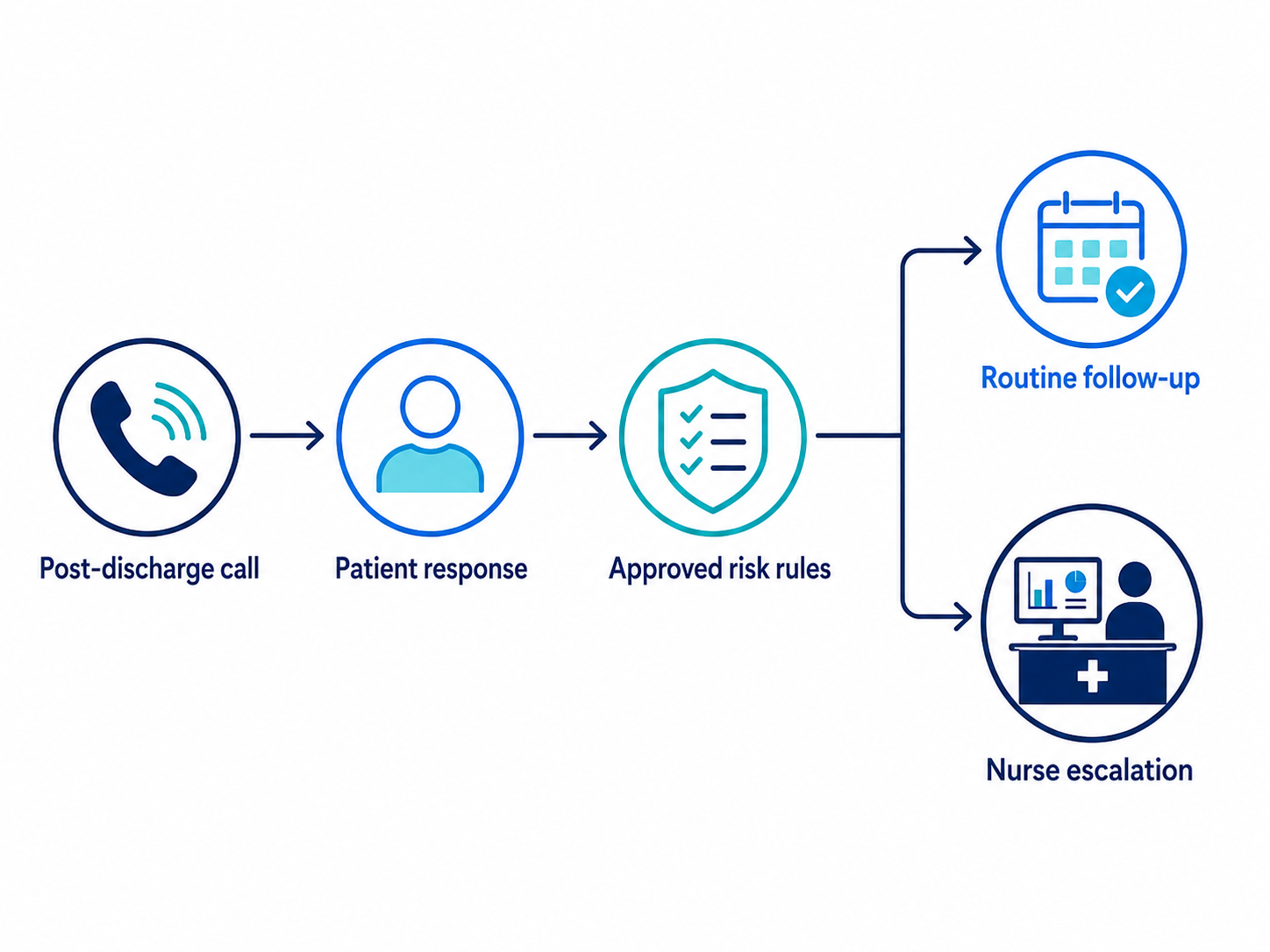
Healthcare teams can use automated voice calls or messages to check whether patients received their discharge instructions, scheduled follow-up care, or encountered an issue after leaving the facility.
If a patient reports a symptom or selects a response that matches an approved escalation rule, the system can alert the care team. It should not diagnose the condition or decide treatment.
7. Chronic-care communication
Patients managing long-term conditions may require recurring communication between appointments. Conversational AI can send medication reminders, appointment prompts, educational material, and scheduled check-in questions.
Responses that fall outside approved ranges can be routed to the care team. This helps staff identify which patients may need direct attention without manually contacting every patient.
8. Billing and payment support
Conversational AI can answer common billing questions, share secure payment links, explain where patients can find account information, and route disputes to billing staff.
Identity verification should take place before the system shares account-specific details.
9. Voice AI agents for front-desk operations
Voice AI agents for healthcare can answer inbound calls, identify why the patient is calling, and complete permitted front-desk tasks. They can also transfer calls with the patient’s intent and conversation history attached.
This is especially useful during call spikes, lunch hours, evenings, and periods when front-desk staff are assisting patients on-site.
How Does Conversational AI Connect with EHR and Healthcare Systems?
Conversational AI becomes far more useful when it can securely retrieve permitted information and record completed actions. Without these connections, the system may answer general questions but cannot confirm availability, schedule appointments, or update patient records.
The required connections depend on the workflow being automated. A conversational AI platform may connect with:
- Electronic health record systems such as Epic or Oracle Health.
- Appointment and resource scheduling systems.
- Patient relationship management platforms.
- Contact-center software.
- Referral management tools.
- Patient portals.
- Billing and payment systems.
- Provider directories and approved knowledge bases.
Each connection should provide access only to the data and actions required for that workflow.
How do HL7 and FHIR support these connections?
HL7 refers to a family of standards used to exchange healthcare information. FHIR, which stands for Fast Healthcare Interoperability Resources, is an API-focused standard maintained by HL7 for representing and exchanging health information. It organizes data into resources such as patients, appointments, medications, and observations.
FHIR can support operations such as reading, creating, updating, and searching available resources. However, a server decides which resources and interactions it supports, so the presence of a FHIR API does not automatically permit every type of read or write action. Its capability statement defines what is available
How does bidirectional synchronization work?
Consider a patient who wants to reschedule an appointment:
- The AI verifies the patient through the provider’s approved process.
- It retrieves permitted appointment and availability data.
- It presents suitable time slots based on the scheduling rules.
- The patient selects a new time.
- The system writes the change back to the scheduling platform.
- It sends confirmation through the patient’s selected channel.
- The interaction is recorded according to the provider’s retention policy.
Bidirectional synchronization means that the conversational platform can both retrieve information and send approved updates. It should not mean unrestricted access to the patient record.
What can go wrong during an EHR integration?
Poorly designed connections can create new administrative problems. Common risks include incorrect patient matching, outdated appointment availability, duplicate records, failed updates, and permissions that provide more access than the workflow requires.
A healthcare organization should test both successful actions and failure paths before allowing patients to use an integrated conversational workflow.
Are Conversational AI Solutions HIPAA Compliant?
Yes, conversational AI can be used in a HIPAA-compliant manner, but compliance is not a feature that can be switched on at the model level. It depends on how the healthcare organization, technology provider, connected systems, staff, and subprocessors handle protected health information.
The HIPAA Security Rule requires covered entities and business associates to use administrative, physical, and technical safeguards for electronic protected health information. These safeguards must protect its confidentiality, integrity, and availability.
How should patient health information be protected?
A healthcare conversational AI deployment should account for the full path taken by patient data, including voice recordings, transcripts, messages, system prompts, integration logs, and staff dashboards.
Security controls should include:
- Encryption for stored data and protected transmission over electronic networks.
- Role-based permissions that limit access by job and workflow.
- Identity verification before account-specific information is shared.
- Multi-factor authentication for staff and administrators.
- Audit logs covering data access, changes, and completed actions.
- Defined data retention and deletion periods.
- PHI masking or redaction where full details are not required.
- Secure backups and tested recovery procedures.
- Incident detection, reporting, and response processes.
A healthcare organization must also conduct a risk analysis covering all electronic PHI it creates, receives, maintains, or transmits. HHS describes this analysis as the first step in selecting reasonable and appropriate security measures.
Why does a Business Associate Agreement matter?
When a conversational AI provider creates, receives, maintains, or transmits PHI on behalf of a covered entity, it will generally act as a business associate. The parties must enter into a Business Associate Agreement that defines permitted uses, safeguards, breach reporting duties, and the handling of PHI after the relationship ends.
How Conversational AI Reduces Revenue Leakage Across the Patient Journey?
Each communication gap creates an opportunity for the patient to delay care, choose another provider, or leave the journey altogether. Conversational AI can help healthcare organizations identify these gaps and continue the conversation until the patient completes the next step or requests human support.
Revenue may be lost at several points across the patient journey:
- Prospective patients abandon calls because of long wait times.
- Website visitors cannot find the right service or booking option.
- Appointment requests submitted after working hours are answered too late.
- Referred patients are not contacted or do not complete scheduling.
- Missing documents prevent referral processing.
- Patients miss appointments because reminders arrive late or through the wrong channel.
- Cancelled appointments remain unfilled.
- Patients do not schedule recommended follow-up visits.
- Inactive patients are never contacted about ongoing care.
These problems may appear to belong to different departments, but they often share the same cause: the conversation stopped before the patient completed the required action.
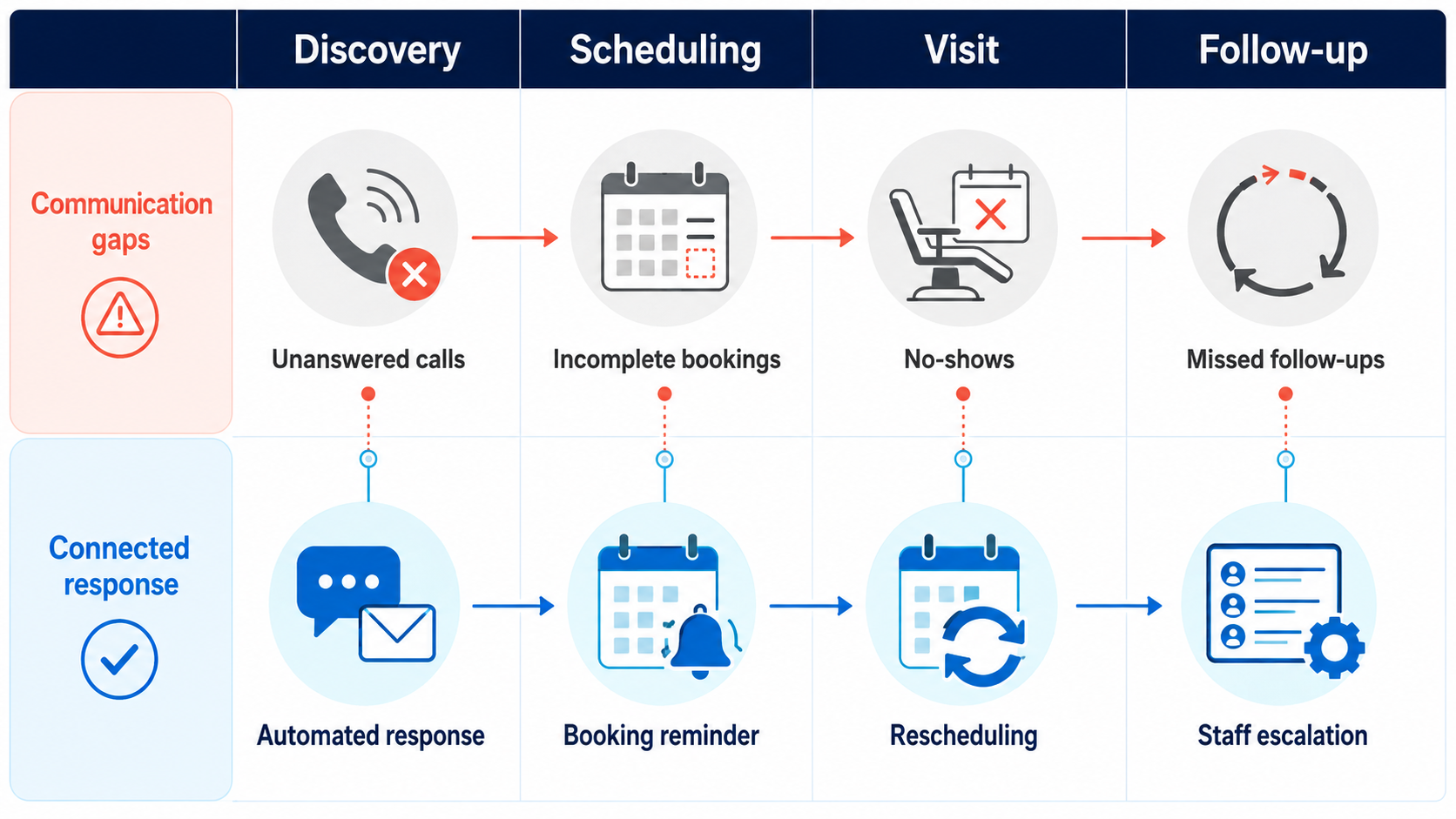
Conversational AI can maintain contact across voice and messaging channels rather than relying on a single phone call or email.
For example, when a patient abandons a scheduling call, an approved workflow could send a message inviting them to continue booking. If a referred patient does not respond, the system can make another contact attempt at a different time or through another permitted channel. When a patient plans to cancel, the AI can offer rescheduling options before the slot is released.
It can also support:
- Immediate responses to new patient enquiries.
- Follow-ups for incomplete appointment requests.
- Referral status updates and missing-information requests.
- Appointment confirmation and preparation reminders.
- Self-service rescheduling and cancellation.
- Waitlist outreach when an earlier slot becomes available.
- Follow-up booking after consultations or procedures.
- Reactivation communication for inactive patients.
Cases that remain unresolved should return to staff queues with the conversation history and the action already attempted.
Healthcare organizations should connect conversational activity with operational and financial outcomes.
The purpose is not to automate every conversation. It is to identify where preventable communication failures affect patient access and revenue, then use automation to keep those journeys moving.
How Conversive Supports Healthcare Conversations Across Voice and Messaging?
Conversive helps healthcare organizations manage patient communication across voice, SMS, WhatsApp, and other digital messaging channels. Instead of treating each interaction as a separate message or call, teams can create connected workflows that continue moving the patient toward the next required action.
A healthcare organization could use Conversive to support:
- New patient enquiries and service routing.
- Appointment booking, confirmation, and rescheduling.
- Referral follow-ups and missing-information requests.
- Pre-visit instructions and reminders.
- Post-visit and post-discharge communication.
- Patient reactivation campaigns.
- Transfers to clinical, billing, scheduling, or support teams.
Workflows can be configured around the organization’s approved content, operating rules, identity checks, and escalation requirements. When a conversation requires staff involvement, it can be routed with the patient’s intent and previous responses attached. This helps the receiving team continue the interaction without asking the patient to repeat everything.
Conversive can also help teams track conversation outcomes, including completed bookings, unresolved requests, transfers, and points where patients stop responding. This allows healthcare leaders to measure how communication affects patient access, staff workload, and revenue recovery.
Book a healthcare Conversational AI demo with Conversive and see how conversational AI could work across your patient journey
Frequently Asked Questions
What is conversational AI in healthcare?
Conversational AI in healthcare is software that interprets patient requests and responds through voice calls, SMS, WhatsApp, web chat, or patient portals. It can answer approved questions, collect information, complete tasks through connected systems, and transfer conversations to staff when manual support or clinical judgment is required.
Is conversational AI the same as a healthcare chatbot?
Not always. Traditional healthcare chatbots usually rely on predefined menus, keywords, and fixed response paths. Conversational AI can interpret varied language, retain context, ask follow-up questions, and complete approved actions. It may also support both voice and messaging, while many basic chatbots operate only through text.
Can conversational AI connect with Epic or Oracle Health?
A conversational AI platform may connect with Epic, Oracle Health, and other EHR systems through supported APIs and approved integration methods. Available actions depend on the healthcare organization’s environment, vendor permissions, FHIR resources, and workflow requirements. Buyers should verify each required read and write action rather than assume universal compatibility.
Can AI voice agents schedule healthcare appointments?
Yes. When connected to the appropriate scheduling system, an AI voice agent can check available slots, collect the patient’s preference, book or reschedule an appointment, and send confirmation. The workflow should include identity verification, permission controls, failed-update handling, and an option to transfer the call to staff.
Can conversational AI provide medical advice?
Conversational AI should not independently diagnose patients, change treatment plans, or make decisions that require qualified clinical judgment. It may provide approved educational information or ask protocol-based questions under defined rules. Symptom reports, emergency requests, uncertain responses, and restricted topics should trigger appropriate instructions or staff escalation.
How much does healthcare conversational AI cost?
Pricing depends on the number of voice minutes, messages, channels, workflows, integrations, locations, and patients supported. Additional costs may include implementation, EHR connection work, workflow design, security review, and ongoing support. Healthcare organizations should compare the total operating cost rather than looking only at the platform subscription.


.avif)