Discover what 18 years building inside Salesforce taught us about AI agents, CRM context, & conversational AI and why context is the key to converting customer conversations.
For 18 years, we built inside Salesforce, not alongside it, not bolted onto it, but natively, as one of the earliest messaging apps on the AppExchange. In that time we carried an enormous volume of conversations for businesses across healthcare, financial services, education, automotive, and real estate, from appointment confirmations and application reminders to re-engagement nudges and service updates. Millions of touchpoints, across thousands of implementations, in industries whose only real similarity was this, someone raises their hand, and revenue depends on what happens next.
We're Conversive now. Most of you know us as SMS Magic. This piece is about what those 18 years taught us, and why it led us to build what we've built. It's a story about a pattern we kept seeing, one that eventually became too important to leave inside a single channel.
18 Years of Salesforce: What We Learned About Customer Conversations
For years, our customer data showed the same pattern. SMS Magic campaigns consistently saw much higher response rates than email, with the same audience, same offers, same season, yet wildly different outcomes.
It would have been easy, and convenient, to conclude that people simply prefer text messages to email. For a while, we believed a version of that too. If we'd stopped there, we'd have built a bigger SMS company. Instead, the pattern kept showing up in places that had nothing to do with SMS specifically, and that's what made us look harder.
Why CRM Context Matters More Than the Messaging Channel
The messages that performed didn't win because they arrived by text. They won because of where they came from, inside Salesforce, carrying the record, the history, the consent status, and the workflow that produced them. A message sent from inside the CRM wasn't a broadcast. It was a continuation of an actual relationship, timed and worded by business logic the recipient had already engaged with.
Take that same content and strip out the context, send it from a system that didn't know who the person was, what stage they were at, or what had already been said and the advantage disappeared, regardless of channel. Context was doing the work. Channel was just the delivery mechanism it happened to be riding on.
That distinction matters enormously for what came next, because it means the thing we'd spent 18 years getting right wasn't “messaging”. It was building conversations that already knew something.
Why Businesses Need Omnichannel Customer Conversations
Customers didn’t stop texting, they simply started reaching out across more channels, on their own terms. A website visitor showing up at 11pm. A phone call during a campaign spike. A comment on a social post. A WhatsApp message. Each of these is now a legitimate front door into a business, and the person on the other end expects the same thing regardless of which door they used, a real answer, close to instantly.
A widely cited Harvard Business Review study, The Short Life of Online Sales Leads, analyzed 1.25 million sales leads across 29 B2C and 13 B2B U.S. companies. It surfaced two insights:
- Speed has a measurable impact: companies that contacted a lead within an hour were nearly 7x more likely to qualify it than those that waited even one additional hour.
- Delay compounds the loss: companies responding within an hour were more than 60x as likely to qualify a lead as those that waited 24 hours or more.
The implication is clear, the first conversation isn't just about responsiveness. It can determine whether demand turns into an actual sales conversation.
On social channels specifically, Sprout Social's Index found that 73% of consumers expect a reply within 24 hours, and the same share say they'll buy from a competitor next time if that reply doesn't come.
Lead Angel reports, responding within 5 minutes increases conversion rates by 21 times, while 84% of consumers say quick response time is critical to authentic customer service. (Emplifi).
All of these stats describe a shift in where conversations start and how fast they're expected to move, a shift that was always going to outgrow any one channel, however well that channel performed.
It also explains why what was once seen as an optional feature, like live chat on a website, is now closer to table stakes. Getting a visitor into an actual conversation, rather than a form, is consistently associated with higher conversion because conversations respond to what people actually ask instead of waiting for them to fill in the right field.
Why AI Agents Need CRM Context to Take Action
The obvious response to “more channels, higher expectations” is more automation, and the market has responded accordingly. Every business now has an AI agent somewhere in its stack, or is being sold one. The trouble is that most of these agents sit on top of the business rather than inside it. They can hold a fluent conversation and answer a general question, but they can't see the opportunity stage, the eligibility rule, the consent record, or what was discussed with this exact person last week. Cut off from that layer, an agent's only real move when something specific is asked of it is to deflect, open a ticket, promise a callback, end the thread.
That's not a knock on the technology. It's the same lesson we learned about channels, now showing up one layer higher in the stack. Intelligence comes from context and access. What an agent can see determines what it can understand, remember, and act on. A perfectly articulate agent without access to the CRM record is, functionally, a well-spoken form.
From Salesforce Messaging to Omnichannel Conversational AI
We didn't replace what worked, we extended it. Everything that made SMS Magic effective, the campaigns, templates, consent logic, routing rules, and automations businesses had spent years configuring inside Salesforce, remains the foundation.
What we built is an extension of that same context principle across every channel where a conversation can begin. That includes web chat, inbound and outbound voice, SMS, RCS, WhatsApp, and social DMs. The underlying logic stays intact as new channels are added. A new channel becomes a configuration step on top of what already exists, rather than a re-implementation project. That continuity is the whole point. The context didn't need replacing, it needed to travel further than one channel could carry it.
We named that broader platform Conversive. Practically, that means a business that built its scheduling logic, its opt-in rules, and its follow-up cadence inside SMS Magic doesn't rebuild any of it to pick up a phone call at 9pm or answer a comment on social media, the same lists, the same triggers, and the same compliance controls extend outward, rather than getting re-created from scratch in a separate tool for every new channel.
How Salesforce Data Gives AI Agents Business Context
Every channel could now carry the conversation. The next question was whether the agent could carry the context.
Underneath Conversive sits Conversive Harness, a layer that reaches into a business's Salesforce metadata, workflows, and logic, and hands that intelligence directly to the conversation. The agent isn't approximating how the business operates from a prompt someone wrote once. It's reasoning with the business's actual rules, the same eligibility criteria, the same routing logic, the same consent state a human team would check. It's less a bot bolted onto the business and more the business, able to hold a conversation itself.
What that looks like in practice differs by business, but the pattern is the same everywhere it runs:
In each case, the agent isn’t guessing at what’s likely true. It’s using the business’s actual data and rules to understand the situation and take the right action.
How Context Connects Customer Conversations to Conversion
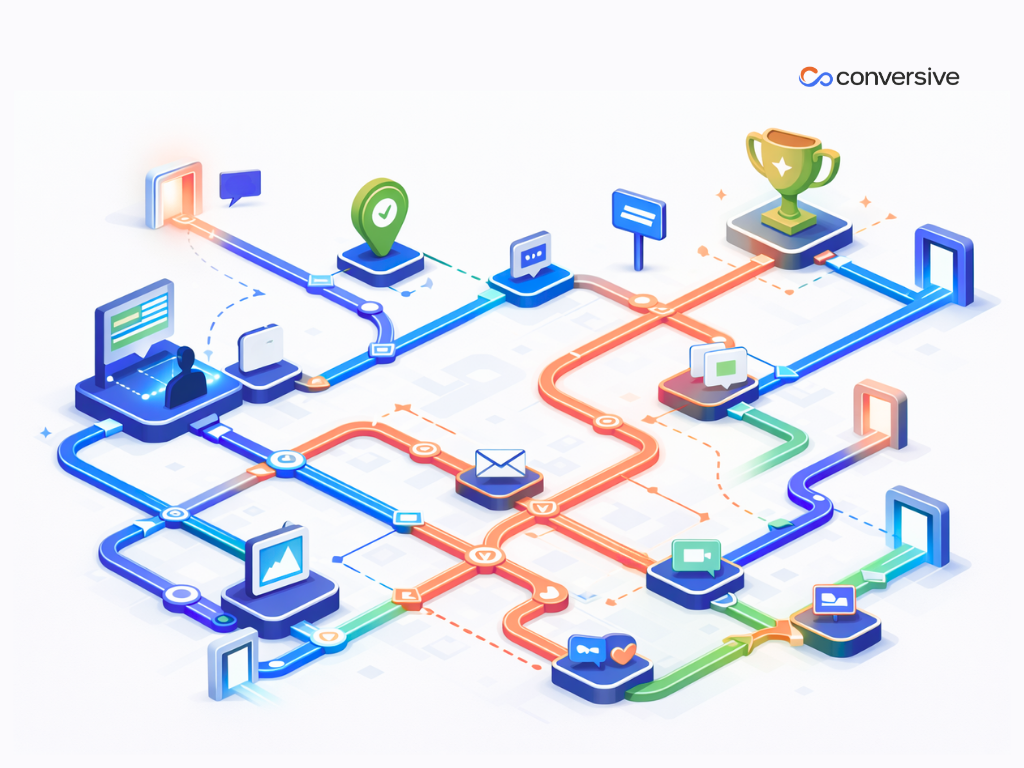
For most of our history, we owned one part of a larger chain from Demand Capture to Demand Nurture to Demand Conversion to Revenue. SMS Magic was built for Nurture, handling the reminders, follow ups, and re engagement that kept a relationship warm between two points of contact. It did that well, and it is still doing it today inside Conversive.
What's different now is that the same context layer runs the full chain, on any channel a conversation happens to start on. An inquiry gets captured the moment it arrives, wherever it arrives. It gets nurtured with the same consistency SMS Magic customers have relied on for years, now available across voice, chat, and messaging rather than one channel. And it gets carried through to conversion, which could be a booking, an application, or a scheduled visit, without losing the context that made the earlier steps work, and without a human having to manually stitch the conversation back together across three different tools that don't talk to each other.
For teams, the real payoff is connecting conversations to outcomes and understanding how many inquiries came in, how many converted, and where the rest dropped off.
Those questions were always the ones that mattered. They were just hard to answer when the phone system, the chat widget, and the messaging platform each held a different piece of the same conversation.
Why Salesforce-Native Conversational AI Is the Next Step
We've been recognized as Salesforce's APAC ISV Partner of the Year in both 2021 and 2022, and we've run inside Health Cloud, Financial Services Cloud, Education Cloud, and real estate CRM implementations long enough to watch the same pattern repeat across every one of them. Conversations convert when they carry context, and they stall when they don't. That's not an industry specific insight. It’s shown up everywhere we've looked, which is exactly why it made sense to build a platform around it rather than a feature.
If you've been running campaigns, automations, and consent logic with us for years, none of that is starting over. It's the foundation the rest of this runs on. The difference is that this foundation can now reach further, into the calls that come in after hours, the web visitors who show up at midnight, and the DMs that used to go unanswered.
The question worth sitting with is whether the context you've already built is reaching every place a customer might actually start a conversation with you. For the businesses we talk to, there’s still room to close that gap.
If you want to see what that looks like against your own Salesforce org, we're happy to walk through it.

Frequently Asked Questions
1. What is Conversive?
Conversive is a demand conversion platform built to help businesses capture, nurture, and convert customer conversations across channels including voice, web chat, SMS, RCS, WhatsApp, and social messaging. It extends the Salesforce-native foundation built by SMS Magic, allowing conversations to carry the same business context across every channel.
2. How is Conversive different from a traditional messaging or AI chatbot platform?
Conversive is designed around context rather than a single channel or standalone AI agent. It connects conversations with Salesforce records, workflows, consent, routing rules, and business logic so agents and teams can understand who they are speaking with and take action based on the actual context of the relationship.
3. What is Conversive Harness?
Conversive Harness is the intelligence layer underneath Conversive that connects conversations with a business's Salesforce metadata, workflows, and logic. It gives AI agents access to the context they need to understand, remember, and act within a conversation based on the business's actual rules and processes.
4. Does Conversive replace SMS Magic?
No. Conversive extends the foundation built by SMS Magic rather than replacing it. Existing campaigns, templates, consent logic, routing rules, automations, and Salesforce configurations remain part of the foundation while new conversation channels and AI capabilities are added around them.
5. Why does context matter in customer conversations?
Context helps businesses turn conversations into meaningful outcomes. When a conversation carries information about the customer, their history, stage, consent, previous interactions, and relevant business rules, teams and AI agents can provide more relevant responses and move the conversation toward outcomes such as a booking, application, sale, or scheduled visit.


.avif)