Revenue leakage is income a business should have earned but never collected. Some of it hides in billing errors, but much of it leaks earlier, when inquiries go unanswered, follow-ups never happen, and appointments are missed. This guide explains the causes, shows examples, and outlines how to measure and close the leaks your P&L never reveals.
Profitability, cash flow, debt-to-equity ratio, operational efficiency, customer growth, customer retention…
All of these are common metrics that companies in every industry regularly calculate and track. And with good reason. These (and many other) metrics enable leaders and decision-makers to understand how the business is performing. Stark numbers and objective data replace guesswork and assumptions, allowing them to spot and address problems early, make better decisions, set clear shared goals, and align teams around those goals.
But there’s one metric that many organizations often don’t measure. And that is revenue leakage.
Revenue leakage can create numerous problems for a business: it erodes profits, leads to unreliable budget and cash forecasts, and lowers enterprise value. To avoid all these issues, it’s critical to measure it alongside all the other “popular” metrics.
But even when it is measured, revenue leakage is usually treated as a “billing” problem: revenue earned but never collected due to either billing or contractual errors. While these errors do contribute to lost business income, they don’t tell the full story.
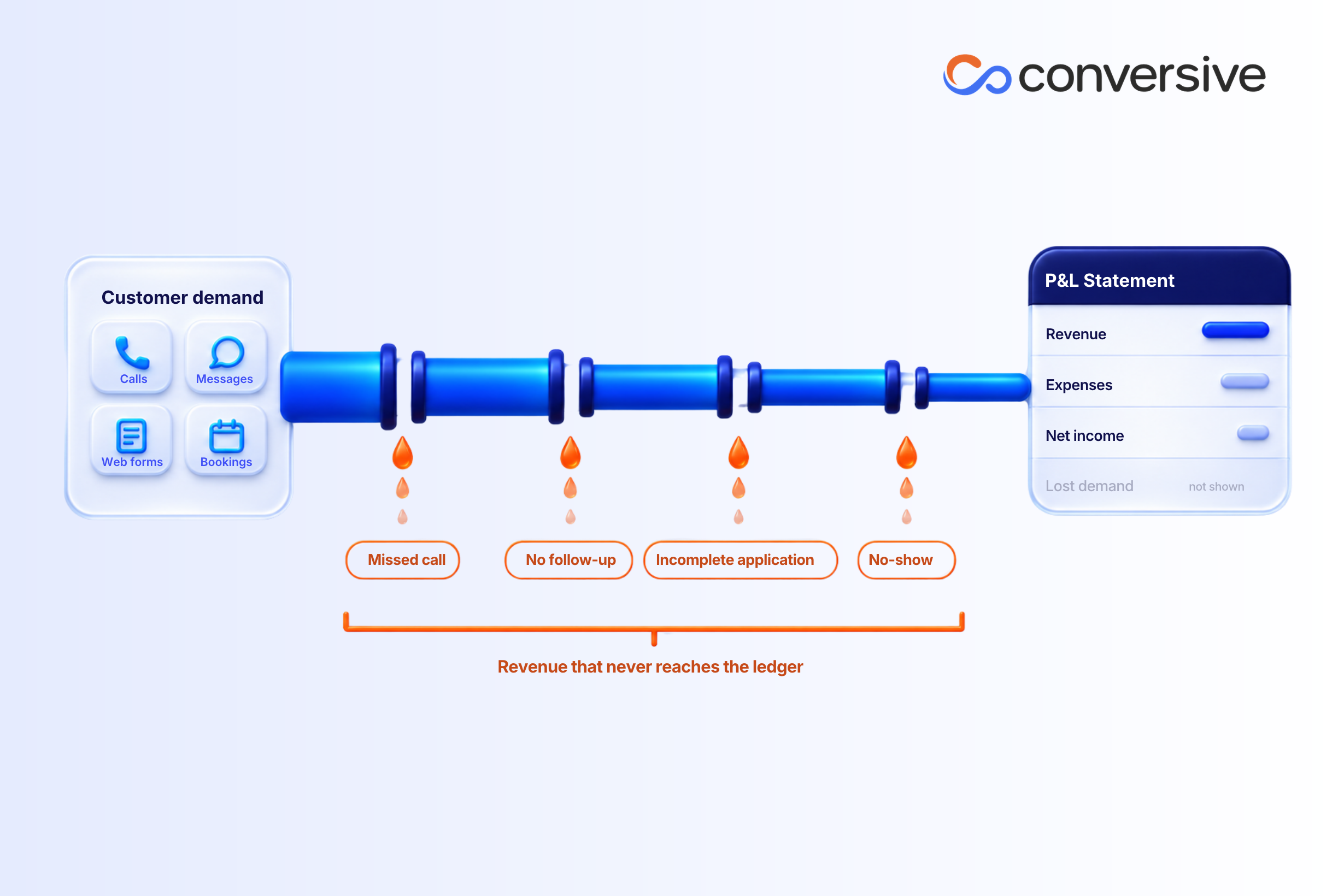
Many businesses, particularly those that depend on inquiries, appointments, consultations, and applications, often lose more revenue earlier in the customer lifecycle. This is when demand arrives but is never answered, followed up, or converted. This revenue loss disappears long before a transaction reaches the billing stage and therefore never shows on the P&L statement. To understand the full extent of revenue leakage, firms need to look beyond their black-and-white ledgers and examine the entire customer journey.
This article explores what revenue leakage means and why businesses should care about it. It also identifies the two types of revenue leakage (billing/contract leakage and customer journey leakage), and outlines strategies to help businesses measure and close the leaks that financial statements never reveal.
What is revenue leakage and why should it matter to businesses?
Revenue leakage is income that a business should (and could) have earned but didn’t collect.
It results from an organization generating financial value (e.g., by delivering a product or service), but failing to capture the corresponding revenue.
Revenue leakage can create serious issues for a business. It strains working capital, weakens cash conversion, and weakens the bottomline. Over time, it may lead to unreliable budget and cash forecasts and curtail the firm’s profitability and viability. It may also increase accounting compliance risks and increase customer churn.
Revenue leakage according to finance teams
Finance teams typically view revenue leakage as a result of operational or systemic gaps, such as billing errors or missed contract renewals. This is what we at Conversive call billing and contract leakage, and it occurs after a business has already delivered a product or service but then failed to collect payment for it.
Example of billing and contract leakage
The sales team at a professional services company have exceeded their sales target for the previous three quarters. But at the end of every quarter, the firm’s revenues are lower than expected. The finance team does a root cause analysis and discovers that the company had been sending out invoices with errors. Thus, even though the firm had technically ‘won’ those sales, they still lost revenues and experienced lower profits.
Revenue also leaks during the customer journey
While billing and contract errors commonly lead to revenue leakage, revenue can also be lost before a transaction even takes place. This is what we call customer journey leakage, i.e., revenue lost because customer demand reached the business but didn’t translate into a revenue-generating transaction.

Example of customer journey leakage
A prospective patient Mr. A calls a clinic ‘Life Medical’ after-hours about a diagnostic scan. They want to know the scan procedure and fasting rules, and want clarity on pricing and insurance coverage. However, no staff member follows up with Mr. A to answer their queries and book the appointment. Mr. A waits for 2 days but still receives no response from the clinic. Tired of waiting, he books a scan with Life Medical’s biggest competitor ‘Optima Diagnostics’. Life Medical never delivers the billable service and thus ends up losing out on the potential revenue they could have earned from Mr. A. In other words, they experience revenue leakage.
Customer journey leakage extends the usual definition of revenue leakage. Even though the revenue is not necessarily earned, the opportunity to do so is still lost. To reduce revenue leakage, businesses, particularly those whose revenues depend on customer conversations – inquiries, appointments, applications, consultations, and so on – need to evaluate ‘stops’ along the customer journey where potential income may be falling through the cracks. Only then can they identify all the sources of preventable revenue loss and act quickly to minimize those losses.
The table below briefly shows the common causes of revenue leaks:
Why revenue leakage doesn’t show on the P&L statement
A profit and loss (P&L) statement is a critical financial document for every for-profit business. It includes several elements like revenues, cost of goods sold, operating expenses, and net income that show whether a firm made a profit or incurred a loss over a specific period. In doing so, the P&L helps decision-makers, investors, and other stakeholders to understand and assess the organization’s profitability and viability.
That said, a P&L only reports actual transactions and revenue. It includes no line item for revenue that was never invoiced or won, so it cannot tell how much revenue the business failed to generate. In other words, it cannot spotlight revenue leakage. And here’s why.
Lost demand leaves behind no transaction
Consider this example.
Mr. A calls a real estate agency to book a tour of a property. However, the receptionist missed the call and so the realtor didn’t follow-up with Mr. A. Consequently, the agency failed to convert the prospect into a paying customer. This resulted in a missed commission, which impacted the business’ topline (gross revenue) and bottomline (net profit).
Like missed calls, unanswered web forms, abandoned applications, cancellations, no-shows, and leads that went cold create no invoices, refunds, or write-offs. These events leave no conventional accounting trail and therefore never appear on the P&L.
Leakage hides in operational data that nobody connects to revenue
While missed customer interactions don’t appear on financial statements, they do leave operational signals within company systems like scheduling tools, phone systems, CRM platforms, contact center platforms, and messaging platforms. This data – call logs, abandoned call reports, CRM lead statuses, appointment no-show lists, etc. – can help to clarify sources of revenue leaks. By evaluating these signals, companies can identify how and when revenue leaks occurred.
But this is easier said than done, because one, these systems often exist in siloes and two, the records themselves are rarely linked to financial outcomes (including revenue). For example, call logs reveal how many inquiries were missed or abandoned, scheduling systems identify cancellations, and messaging records which customer interactions resulted in bookings, applications, or purchases. However, none of these systems show the financial impact of these issues. A customer communication platform can ease this challenge. Conversive’s platform connects customer data, conversational history, and business knowledge into a shared intelligence layer. This helps close gaps between demand and conversion, reducing the chances of revenue leakage.
Revenue leakage occurs differently in different industries, depending on how they operate and generate income. The following examples illustrate how billing problems and customer journey breakdowns can occur within the same organization.
The customer journey examples demonstrate why accounting controls alone cannot address revenue leakage. Businesses must also examine how effectively they interact with customers, respond to their demands, and convert revenue-generating opportunities into actual revenue.
Revenue leakage and impact in healthcare: Hypothetical example
Here’s a hypothetical scenario that illustrates how revenue may leak for a healthcare organization – and its potential financial impact:
A multi-location dental group misses 25 new-patient calls a week. A new patient is worth $1,200 in the first year. Let’s assume that 40% of those callers would have booked an appointment
By missing these hot prospects, the organization’s estimated financial loss would be:
25 calls × 52 weeks × 40% × $1,200 = $624,000 per year

This is the leaked revenue the organization could have earned – but doesn’t appear on the P&L because those prospects never actually became patients (paying customers).
Calculating revenue leakage
As we have seen, revenue leakage does not appear on any financial statement. But this doesn’t mean that it cannot be calculated. In fact, businesses should avoid relying on industry-wide “average leakage” numbers to pinpoint and analyze their own leakage sources. Their own operational records and systems can provide a much more credible estimate for further analysis.
Here’s how to calculate revenue leakage due to billing leakage and customer journey leakage.
Billing leakage: Comparing expected revenue versus billed revenue
Billing Leakage = Expected Billable Revenue – Actual (Billed) Revenue
Billing Leakage Rate (%) = Expected Billable Revenue – Actual (Billed) Revenue x 100
Expected Billable Revenue
Example
Firm F delivers $500,000 worth of services to Customer C during the year. However, the invoices (4 total, 1 per quarter) only add up to $450,000.
So, Billing Leakage = 500,000 – 450,000 = $50,000
Billing Leakage Rate (%) = 50,000 x 100 = 10% = 500,000
The company must then investigate the causes of the billing leakage.
Customer journey leakage: Assessing missed opportunities, conversion rates, and customer value
Customer Journey Leakage = Missed or Unconverted Opportunities x Expected Conversion Rate x Average Revenue Per Customer
The above inputs can be obtained from various operational systems:
Example
A university U identifies 100 missed inquiries from potential international students over the previous academic year. It has an expected conversion rate of 30% and generates an average of $30,000 per student per year.
So,
Estimated Revenue Leakage = 100 x 30% x 30,000 = $900,000
Strategies to prevent billing and customer journey revenue leaks
Revenue leakage is a persistent problem in many industries. Fortunately, it’s possible to prevent – or at least minimize it. The following strategies can help:
It’s also useful to automate follow-ups, reminders, and rebooking workflows.
- Automated reminders can prompt customers to complete quotes or applications, or confirm appointments.
- Automated follow-up messages can re-engage prospects who have not responded and move them down the funnel towards an appointment, subscription, or sale.
- Automated rebooking workflows can help firms recover appointments missed through no-shows.
These automations help businesses to close the gaps where customers drop off and revenue leaks across various points of the customer journey: awareness, consideration, acquisition, conversion, delivery, and retention/renewal. There’s less need to rely on human inputs, abilities, and memory, so there are fewer chances of errors that typically cause customer journey leaks.
But to implement these fixes, it’s critical to connect previously siloed data and systems to each other and to the firm’s system of record (e.g., CRM). This ensures that nothing gets lost between channels, interactions, or teams. And here’s where a communication layer comes in. The most effective way to implement this layer is with a demand capture and conversion platform. Enter Conversive.
Close revenue leaks in the customer journey with Conversive
Conversive is an AI-powered demand capture and conversion platform connected to Salesforce CRM. It empowers businesses to address customer journey leakage by combining the power of AI, contextual intelligence, and human expertise.

Conversive helps connect every conversation on every channel to the CRM, ensuring that the outcome and context of every previous interaction is always available to guide future interactions. It also captures, qualifies, converts, and nurtures customer demand, ensuring that this demand doesn’t get lost along the customer journey.
Through Conversive, businesses can:
- Respond to every inquiry: Engage customers across voice, SMS, WhatsApp, and web chat, including after hours, using conversational AI where configured.
- Automate follow-ups and reminders: Run follow-ups, confirmations, and rebooking workflows based on defined business rules.
- Engage in personalized, Salesforce-connected conversations: Record conversations and outcomes against the customer record so leaks become visible in reporting.
- Ensure human handoffs through a unified inbox: Transfer conversations to staff with full history when judgment is needed.
And in doing so, they can capture more demand, reduce communication gaps, and take proactive action to identify and plug customer journey leakage.
Conversive creates a unified intelligence layer that helps move every conversation towards a profitable outcome. To know more, ask our team for a free demo. Click here (link) to get started.
Frequently Asked Questions (FAQs)
1. What is revenue leakage in simple terms?
Revenue leakage is the money a business has earned by selling a product or service, but failed to collect due to billing errors, missed contract renewals, failed payments, unrecorded charges, or unbilled services. Missed customer inquiries and incomplete follow-ups can also contribute to revenue leakage.
2. What is an example of revenue leakage?
An example of revenue leakage is a healthcare clinic failing to follow up with new patient inquiries, so they miss the opportunity to book these individuals for new appointments, and ultimately miss out on potential new revenues.
3. What is the difference between revenue leakage and churn?
Revenue leakage is revenue earned but not properly collected due to preventable operational and billing gaps during the customer journey. Churn refers to the loss of existing customers (and thus revenue) due to customers discontinuing their relationship with a business through account cancellations, shrinkages, or downgrades. Both contribute to revenue loss, but are distinct metrics and stem from different causes.
4. How much revenue do companies lose to leakage?
There is no single “average” figure for revenue leakage. In general, the amount of revenue that companies lose to leakage depends on multiple factors, including industry, pricing model, billing processes and complexity, contract terms, discount errors, customer communication processes, and conversion performance.
5. What is a revenue leakage audit?
A revenue leakage audit is a systematic, structured review of an organization’s billing and revenue generation processes and systems. The goal is to compare expected revenue against actual revenue in order to understand how much money the business earned but never actually billed or collected.
6. What is the difference between revenue leakage and patient leakage in healthcare?
For a healthcare provider, patient leakage, also known as referral leakage or network leakage, refers to patients receiving care from a different provider or practice. Revenue leakage refers to revenue that the organization failed to capture despite already delivering care. It can happen across the revenue cycle (registration to payment follow-up) and adversely affect the organization’s bottomline.