
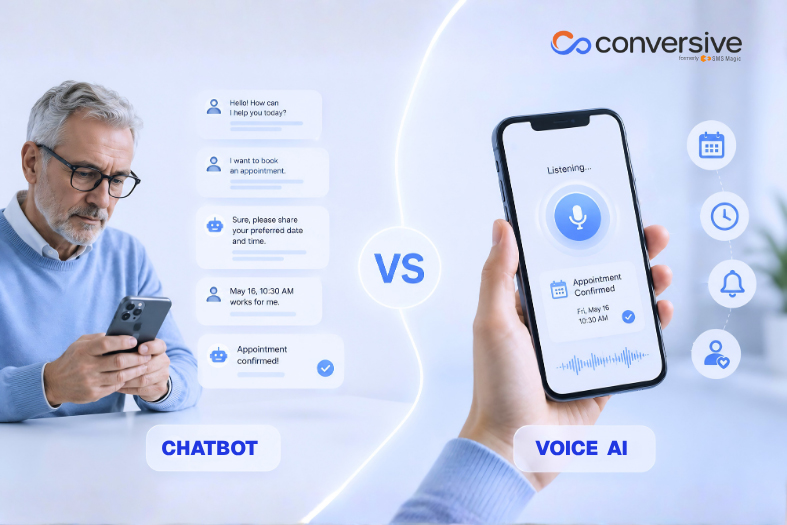
It’s mid-night. A 77-year-old cardiac patient suddenly feels his heart skipping beats. The room is quiet, he thinks of dialing 911 but then hesitates…this doesn’t feel serious enough to call emergency services, but it’s too alarming to ignore.
He reaches for his phone and opens a hospital chatbot and types his symptoms. A menu appears. Then another. And another. Minutes pass, but he’s still searching for something simple, clarity. Frustration builds. Eventually, he stops trying.
Now rewind.
Same night. Same patient. Same symptoms. But this time, a voice AI answers within seconds. It recognizes his history, listens without interruption, and responds in calm, human language. It asks the right questions, guides him through what to check, and helps him decide what to do next.
He feels heard. Reassured he goes to bed, and in the morning, he schedules a follow-up.
That gap, between searching for answers and receiving real, immediate care, is the difference that matters most.
The Market Is Speaking. Are We Listening?
Patients pick chatbots or voice AI not because of how fancy the technology is, but because they feel understood and in control of the conversation.
A 2025 qualitative study published in the National Library of Medicine followed patients managing atrial fibrillation through conversational AI phone calls over six months. The results were telling. Patients found voice-based conversational AI engaging for self-management support, but they specifically wanted more dialogue flexibility, personalized content, and interactions that felt less scripted and more natural.
That single finding should reshape how every product manager and CX leader in healthcare thinks about channel strategy.
So, Chatbot or Voice? The Real Answer Is Context.
Chatbot or voice, there is no universal winner. Instead, the right choice depends on the situation and what the user needs at that moment.
Chatbots work brilliantly for:
- appointment scheduling
- prescription refill requests
- insurance pre-authorizations
- lab result notifications
These are transactional, low-emotion interactions where speed and precision matter more than tone.
Voice AI earns its place in:
- post-discharge follow-ups
- chronic disease check-ins
- medication adherence reminders
- mental health check-ins
- any interaction where a patient's emotional state is part of the clinical picture
When someone is anxious, confused, or elderly, reading and typing is a barrier. Speaking is instinct. So the ideal move is, deploy the right channel for the right moment, not the cheapest one for every moment.
Three Things Patients Actually Want in 2026
First, they want to feel heard, not processed. Generic responses kill trust faster than silence. Personalization, even something as small as referencing a patient's last visit, changes the tone of an entire interaction.
Second, they want continuity. Patients are exhausted by repeating themselves. A voice AI that does not know what the chatbot already collected is not an assistant, it is another obstacle. Seamless data handoff across channels is now a baseline expectation, not a differentiator.
Third, they want transparency about what AI can and cannot do, including its limitations and where human oversight is required. This leads into the ethical considerations that many vendors tend to underemphasize.
How Conversive Aligns Chatbots and Voice AI with Patient Intent
Conversive doesn’t treat chatbots and voice AI as competing channels. It treats them as complementary tools within a single, unified patient experience. The goal isn’t to force patients into one interface, it’s to meet them in the moment with the interaction style they need.
Here’s how Conversive makes that work:
Context-Aware Channel Switching
Conversive understands when a patient’s need shifts from transactional to emotional. A simple chatbot interaction can seamlessly transition to voice when complexity or urgency increases, without forcing the patient to start over.
Unified Patient Memory
Every interaction, whether typed or spoken, is connected. Patients never have to repeat symptoms, history, or preferences. The system carries context forward, creating a continuous, human-like conversation across channels.
Natural, Adaptive Conversations
Conversive’s voice AI isn’t rigid or scripted. It adapts in real time, asking relevant follow-ups, adjusting tone, and responding in a way that feels intuitive rather than mechanical.
Right Channel, Right Moment
From quick scheduling via chat to sensitive follow-ups through voice, Conversive intelligently routes interactions based on intent and patient profile, not just system defaults.
Accessible by Design
Whether a patient prefers typing, speaking, or switching between both, Conversive ensures the experience is inclusive, especially for elderly users, non-native speakers, and those less comfortable with digital interfaces.
Move from Interaction to Understanding with Conversive
If your patient experience still feels fragmented, where conversations reset, context gets lost, and patients are left choosing between channels instead of being guided through them, it’s time to rethink the approach.
Conversive helps healthcare organizations unify chat and voice into a seamless, patient-first experience that adapts in real time, so every interaction feels connected, intuitive, and genuinely supportive.
Afterall, better conversations don’t just improve engagement, they lead to better care decisions. See how it works in practice, book a demo.